
Termites cause more structural damage to residential and commercial properties each year than fires and floods combined — yet standard homeowners insurance policies almost universally exclude termite damage, classifying it as a preventable maintenance failure. This single fact transforms anti-termite treatment from an optional expense into a non-negotiable property investment.
This guide explains precisely what anti-termite treatment is, how each method works, how long treatments last, and what homeowners must know before hiring a professional — so you can make a fully informed, financially sound decision.
Why Termites Pose a Severe Structural and Financial Risk
The Silent Destruction Pattern
Termites operate from the inside out. Structural beams, floor joists, and door frames can be extensively hollowed while the exterior surface appears entirely intact. By the time visible signs emerge — bubbling paint, hollow-sounding wood, or mud tubes along walls — the damage has often already accumulated over months or years.
Subterranean termites represent the most destructive species globally. Among them, the Formosan subterranean termite is the most aggressive, capable of building self-contained aerial nests inside walls wherever a plumbing or roof leak supplies sufficient moisture. This renders standard soil-based barriers insufficient if a moisture source is not simultaneously addressed.
The Insurance Gap Homeowners Overlook
No financial safety net exists for termite damage under a standard property insurance policy. Insurers classify such damage as the result of poor maintenance — a preventable condition that the homeowner is expected to manage proactively. This makes professional anti-termite treatment the only reliable mechanism for protecting the structural and resale value of a property.
What Is Anti-Termite Treatment? A Precise Definition
Anti-termite treatment refers to a structured system of chemical, physical, or biological interventions designed to eliminate existing termite colonies and establish a durable barrier against future infestation. The process follows three stages: Inspection → Extermination → Prevention.
Two fundamental categories apply to every property:
- Curative treatment: Applied to eradicate an active infestation within an existing structure
- Preventive treatment: Applied proactively — ideally during construction — to eliminate the conditions under which termites can establish entry
A Brief History: Why Modern Treatments Last Fewer Years
Until the late 1980s, exterminators used organochlorine compounds such as Chlordane and Heptachlor, which provided 20 to 30 years of protection due to their extreme environmental persistence. These compounds were banned globally through the 1990s following serious health and ecological concerns.
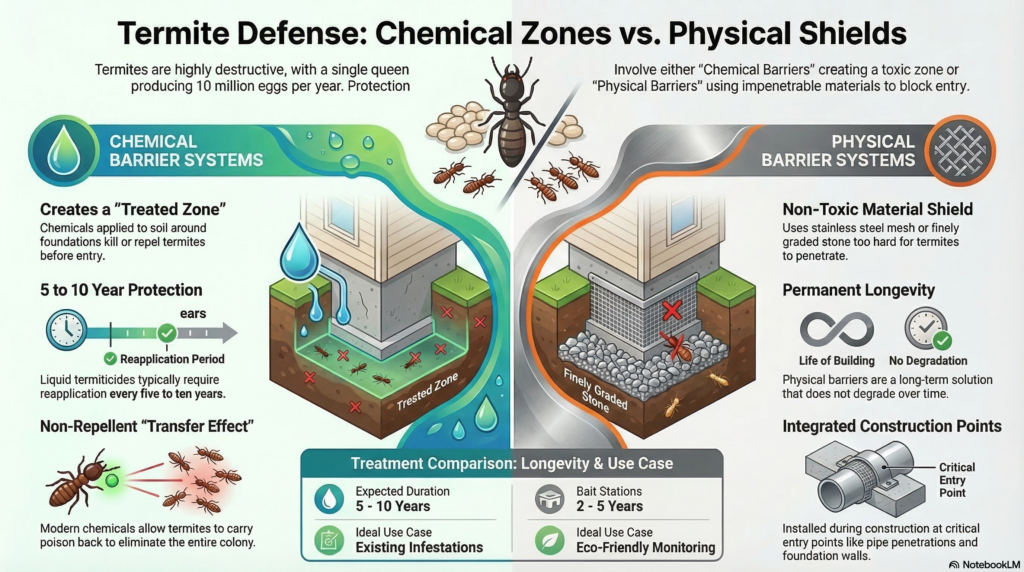
Today’s approved termiticides — primarily Imidacloprid, Fipronil, and Bifenthrin — are significantly safer and more environmentally responsible, but they break down in soil within 5 to 10 years. This accelerated degradation is the primary reason Annual Maintenance Contracts (AMCs) exist and why periodic reapplication is now standard professional practice.
Pre-Construction Anti-Termite Treatment
Why It Remains the Gold Standard
Pre-construction treatment is applied to the soil and foundational elements before concrete slabs are poured, establishing an unbroken chemical barrier that termites cannot access once the building is complete. It is substantially more cost-effective and comprehensive than retrofitting protection onto an existing structure.
The Four Treatment Stages During Construction
- Foundation trench treatment — Chemical emulsion is applied to trench bottoms and sides, typically at 5 litres per square metre of surface area
- Column pit treatment — Soil surrounding structural columns is treated before backfilling is completed
- Wall-floor junction treatment — A 3 cm × 3 cm channel is cut at all wall-floor junctions; rod holes are drilled at 15 cm intervals and emulsion is injected to create a vertical chemical curtain
- Plinth filling treatment — The consolidated earth surface within plinth walls is treated before the stone bed is laid
Advanced Option: Reticulation Systems
For high-value or multi-storey buildings, a reticulation system — a network of perforated pipes installed beneath the slab at plinth level — allows fresh termiticide to be periodically pumped into the soil without ever drilling through finished flooring. This system converts a one-time treatment into a permanently maintainable barrier.
Physical Barriers: The Chemical-Free Alternative
If chemical treatment is not preferred or feasible, physical barriers can be incorporated at the construction stage:
- Stainless steel mesh installed at all pipe penetrations and weep holes, with apertures smaller than 0.5 mm
- Graded particle barriers using crushed basalt or granite (8–14 grit) packed beneath slabs — stones must be too heavy for termites to move yet packed too tightly to squeeze between
- Elastomeric waterproofing membranes applied to foundation walls, which also function as moisture barriers
Physical barriers do not degrade over time and can remain effective for 20 years or more — significantly outlasting chemical alternatives.
Post-Construction Anti-Termite Treatment
When and Why It Becomes Necessary
Post-construction treatment is applied to buildings that were not treated during construction, or those requiring retreatment after a chemical barrier has degraded or been compromised. While more invasive and costly than pre-construction treatment, it remains highly effective when applied professionally.
The Standard Post-Construction Process
- Trenches are excavated around the exterior perimeter of the foundation and treated with termiticide at approximately 7.5 litres per square metre of vertical surface
- Holes are drilled through concrete slabs and floor-wall junctions at regular intervals; termiticide is injected deep into the sub-slab soil, and holes are sealed with matching cement
- Interior wall-floor junctions are treated using the same channel-and-injection method
Repellent vs. Non-Repellent Termiticides
| Feature | Repellent (e.g., Bifenthrin) | Non-Repellent (e.g., Imidacloprid, Fipronil) |
|---|---|---|
| Detection by termites | Termites detect and avoid treated zones | Completely undetectable to termites |
| Colony elimination | No — diverts the colony | Yes — spreads via trophallaxis to queen |
| Best application | Preventive perimeter barriers | Active infestations; alkaline/alluvial soils |
| Speed of action | Immediate repellency | Slower but more complete |
Non-repellent formulations are generally preferred for active infestations because termites unknowingly carry the chemical back to the colony through trophallaxis — the colony’s food-sharing behaviour — ultimately reaching and eliminating the queen.
Termite Bait Stations: Colony Elimination at the Source
Bait stations containing cellulose material laced with slow-acting insect growth regulators (IGRs) such as Hexaflumuron are installed at regular intervals in the soil around a property. Foraging termites feed on the bait, return to the colony, and transfer the active ingredient through trophallaxis, progressively collapsing the entire population including reproductives.
Baiting vs. Liquid Barriers — Key Differences:
| Factor | Liquid Barrier | Bait System |
|---|---|---|
| Protection speed | Immediate | Weeks to months |
| Colony elimination | No | Yes |
| Environmental footprint | Moderate | Minimal |
| Maintenance requirement | Annual AMC inspection | Quarterly monitoring |
| Effective lifespan | 5–10 years | Ongoing with maintenance |
Bait systems are particularly appropriate for eco-conscious property owners or situations where extensive soil drilling is impractical. However, for immediate structural protection, a liquid termiticide barrier remains the superior choice.
Eco-Friendly and Natural Treatment Options
Several botanical and non-synthetic alternatives are available for prevention or minor visible infestations:
- Neem oil (Azadirachtin): Functions as an insect growth regulator, preventing molting and reproduction — does not kill on contact but collapses colony growth over time
- Orange oil (d-limonene): Dissolves the termite’s waxy exoskeleton on contact, causing rapid dehydration — effective for localised drywood infestations
- Borates (Borax/Disodium octaborate): Penetrates wood and disrupts termite digestive systems; also inhibits mould that termites depend on
- Diatomaceous earth: Microscopic particles abrade the cuticle, causing fatal dehydration through a purely physical mechanism
Critical limitation: Natural treatments are not adequate for severe or deep subterranean infestations. All organic formulations degrade faster than synthetics and require more frequent reapplication to maintain any protective effect.
How Long Does Anti-Termite Treatment Last?
| Treatment Type | Effective Lifespan |
|---|---|
| Liquid soil termiticide | 5–10 years |
| Bait station system | Ongoing (quarterly maintenance) |
| Physical barriers | 20+ years |
| Natural/organic treatments | 1–3 years |
| Thermal heat treatment | Permanent (for treated area) |
Treatment longevity is significantly affected by soil composition, moisture levels, and physical disturbances. Sandy soils degrade chemical barriers more rapidly than clay-based soils. High humidity accelerates breakdown, as do plumbing repairs, new landscaping, or soil settlement — all of which can create untreated gaps that termites will exploit immediately. These disruptions also represent the most common grounds for voiding an AMC warranty.
The Case Against DIY Termite Control
Store-bought repellent sprays address only visible surface termites while leaving the hidden colony intact. More critically, repellent applications can cause colonies to “bud” — a defensive fracturing response in which the colony segments and spreads to previously unaffected areas of the structure, actively accelerating damage.
Professional intervention is essential for the following reasons:
- Accurate species identification (subterranean, drywood, or Formosan) — treatment strategies differ fundamentally per species
- Safe application of restricted-use termiticides at correct dilution rates
- Comprehensive infestation mapping using acoustic emission devices, microwave radar (Termatrac), moisture meters, and thermal cameras
- Provision of legally binding warranties and AMC coverage with defined retreatment obligations
Before engaging any pest control firm, request written confirmation of the chemical being used, the concentration, the treatment method, and precisely what conditions void the warranty.
Anti-Termite Treatment and Real Estate Transactions
Active termite infestations or documented structural damage require disclosure during property transactions. Many lenders and financial institutions require a clear professional termite certificate before approving a home loan — a failed inspection can suspend or collapse an entire purchase. Treatment costs are frequently negotiated as part of the closing process, with sellers either covering the cost or accepting a corresponding reduction in the sale price. A property with a documented treatment history and active AMC represents a verifiably maintained asset that supports a stronger market valuation.
FAQs
It is a professional process of applying chemical, physical, or biological measures to prevent termites from entering a structure or to eliminate an existing colony.
Liquid soil treatments typically last 5 to 10 years. Physical barriers can last over 20 years. Bait systems require ongoing quarterly maintenance to remain effective.
DIY treatment is not recommended. Incorrect application can cause colonies to spread (budding), contaminate water sources, and leaves the property without any professional warranty.
Costs vary by property size, treatment type, and location. Pre-construction treatment is the most economical per square foot; whole-structure fumigation for severe drywood infestations is the most expensive. Always obtain a written quote that includes AMC terms.
Digging near the foundation, plumbing repairs, new landscaping against exterior walls, or any construction that disturbs the treated soil layer can create untreated gaps and void the warranty.
Modern termiticides have minimal odour once dry. Professionals generally advise re-entry within 4 to 6 hours post-application, though specific guidance depends on the chemical used.
No. Standard property insurance policies classify termite damage as a preventable maintenance issue and do not provide coverage. Professional anti-termite treatment and an active AMC are the homeowner’s primary financial protection.