
Hey there, fellow Hyderabadis! If you’ve spent any time driving through Gachibowli, Madhapur, or the rapidly expanding Kondapur corridors lately, you’ve seen it: cranes everywhere. Hyderabad isn’t just the “Genome Valley” or a global pharmaceutical hub anymore; it’s a city of soaring dreams and even taller apartments.
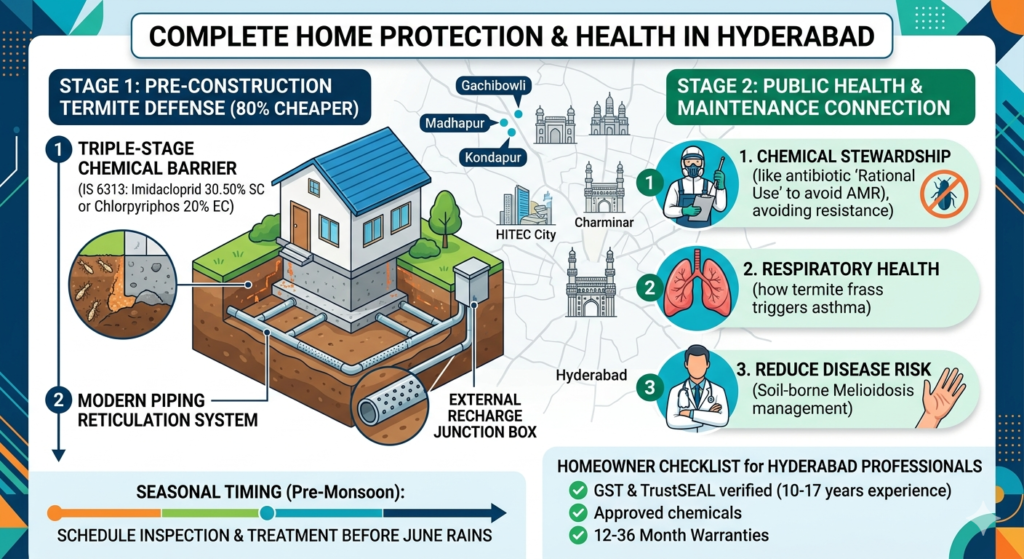
But while we’re busy picking out the perfect Italian marble or teakwood doors, a silent army is waiting beneath the red soil. I’m talking about termites. In our tropical climate, these little guys aren’t just a nuisance—they’re a financial disaster waiting to happen.
Today, let’s chat about how to protect your home from the ground up, why the “monsoon” is your biggest warning sign, and how property maintenance actually links back to your family’s health.
1. Hyderabad’s Urban Boom and the “Silent Destroyers”
We live in a city that produces over 35% of India’s drugs. We have the best tech and the best biryani, but we also have the perfect environment for termites. The rapid construction in our high-growth corridors often disturbs massive, ancient underground colonies.
When we build over their homes, they simply move into ours. Termites are known as “silent destroyers” because they can chew through a door frame or a kitchen cabinet for years before you ever see a single “mud tube.” By the time you notice the damage, the bill is usually in the lakhs.
The Healthcare Twist: Chemical Stewardship
Here’s something most pest control ads won’t tell you: property maintenance is a public health issue. Just as doctors at Osmania General Hospital warn us that using the wrong antibiotics (like overusing the “Watch” group) leads to superbugs, using the wrong chemicals on your soil can lead to “resistant” pests and environmental runoff. Doing it right the first time isn’t just about saving money; it’s about being a responsible citizen in the “Pharmaceutical Capital of India.”
2. Pre- vs. Post-Construction: Why Prevention is Your Best Investment
If you are currently building a home or a small office, stop and read this carefully. Prevention is literally 80% cheaper than a cure.
Current Market Rates (2026 Estimates)
- Pre-Construction Treatment: Usually costs between ₹3–₹6 per sq. ft. * Post-Construction (The “Oops” Phase): Can skyrocket to ₹25–₹50 per sq. ft. because it involves drilling into your expensive flooring.
The 3-Stage “Primary Line of Defense”
To do it right, your builder should follow these technical stages to create an unbroken chemical barrier:
- Stage 1 (The Trenches): Treating the bottom and sides of the foundation trenches at a rate of 5 liters per square meter.
- Stage 2 (The Backfill): Treating the vertical soil that touches your masonry foundation.
- Stage 3 (The Plinth): Treating the top surface of the consolidated earth before the sand bed and floor slab are poured.
3. Beyond Traditional Spraying: The Rise of Piping Reticulation Systems
If you’re building in a modern area like the Financial District, you’ve probably heard of Piping Reticulation.
Imagine a network of specialized, porous pipes buried under your floor before the tiles go down. Instead of drilling holes in your house five years from now, you simply call a professional who pumps the chemical into an external junction box.
- The Big Win: No drilling, no smell inside the house, and 100% coverage.
- Expert Tip: If your soil is rocky or very compacted (typical of some Hyderabad terrain), make sure your contractor uses 12mm steel rods to create “seepage holes” so the chemical actually reaches the deep layers of the foundation.
4. Seasonality: Managing the “Solar” and “Monsoon” Cycles
In Hyderabad, our health and our homes are tied to the weather.
The Termite Calendar
- Solar Season (March–June): The heat and humidity are like a “dating app” for termites. This is when they breed and expand their colonies.
- Monsoon Season (June–September): When the ground gets saturated with those heavy Deccan rains, termites look for dry land. That “dry land” is usually the wood inside your foundation.
Pro Tip: Always schedule your professional inspection before the June rains start. Once the ground is soaked, applying chemicals becomes much less effective.
5. Health Risks: It’s Not Just About the Wood
You might think, “It’s just a bug, what’s the big deal?” Well, it’s more than that.
Respiratory Issues
Termites produce “frass” (a mix of wood dust and droppings). When this gets into your AC vents, it can trigger asthma attacks and chronic allergies for your kids or family members older than 70.
The Melioidosis Connection
This is a rare but serious soil-borne infection caused by the bacterium Burkholderia pseudomallei. It’s often found in tropical soil like ours. When untrained people dig into infested, untreated soil without protection, they risk exposure. This is particularly dangerous for people with diabetes. Professional pest control helps manage the soil environment and reduces the risk of disturbing dangerous bacteria.
6. Choosing a Partner: How to Spot a Professional in Hyderabad
Don’t just hire the guy with the cheapest spray can. This is your biggest investment!
- Vetting Checklist: * GST & TrustSEAL: Check platforms like IndiaMART for verified providers with at least 10 years of experience.
- The Chemical Test: Ask for Imidacloprid 30.50% SC. It’s the gold standard for long-term protection.
- The Warranty: A “service guarantee” is not a “structural warranty.” A real professional in Hyderabad should offer a warranty ranging from 12 to 36 months.
Conclusion: Building a Resilient Hyderabad
Protecting your home from termites isn’t just about saving your furniture; it’s about peace of mind. As our city grows into a global powerhouse, let’s build structures that last for generations. Don’t wait until you see the mud tubes on your beautiful walls—take action today!
Frequently Asked Questions (FAQs)
Yes, as long as it’s done by professionals. Modern chemicals like Imidacloprid are applied deep into the soil or behind walls. Once the chemical dries (usually a few hours), it poses minimal risk to pets, but always keep them away during the actual application!
With the red, loamy soil found in many parts of Hyderabad, a professional pre-construction treatment usually lasts 5 to 10 years. However, a yearly inspection is highly recommended due to our high moisture levels during the monsoon.
Please don’t! While kerosene might kill a few termites on contact, it doesn’t reach the “Queen” in the colony deep underground. It’s also a huge fire hazard. Professional “non-repellent” chemicals ensure the termites carry the poison back to the nest, wiping out the whole colony.
Newer areas are often built on recently cleared land or near rocky outcrops where termites have lived for decades. Construction disturbances “wake them up,” and the moisture from new plumbing gives them the perfect environment to thrive.
Unfortunately, most standard home insurance policies in India consider termite damage “preventable” and do not cover it. This is why spending a few thousand rupees on prevention today can save you lakhs tomorrow!