
Introduction to Mumbai’s Urban Termite Ecology
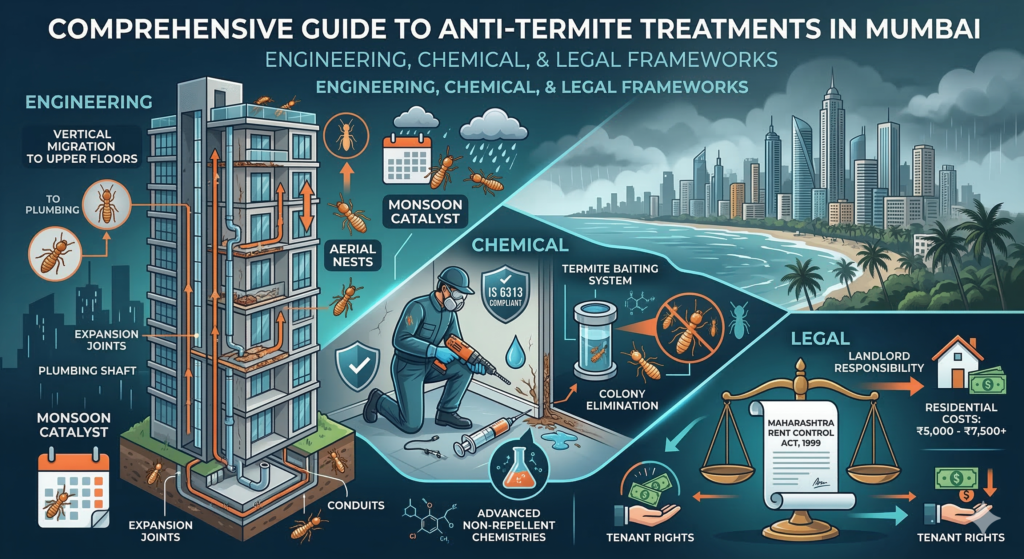
Termites are responsible for massive structural degradation globally, inflicting billions of dollars in economic damage annually. In the dense urban environment of Mumbai, the ecological conditions are exceptionally conducive to subterranean termite proliferation. The city’s coastal geography, high relative humidity, and intense monsoon seasons provide the requisite moisture and temperature for colonies to thrive. While urbanization has largely displaced natural woodland habitats, termites have aggressively adapted to the built environment, utilizing the structural timber, paper, and cellulose materials present in residential and commercial buildings as their primary sustenance. Managing this threat requires a comprehensive understanding of architectural vulnerabilities, stringent adherence to standardized chemical protocols, and clarity regarding property law.
Architectural Vulnerabilities in Mumbai Real Estate
The High-Rise Paradox
A pervasive misconception in urban property management is that high-rise structures are immune to subterranean termite infestations. However, professional pest management assessments in the Mumbai and National Capital Region markets confirm that termites can easily infiltrate apartments located on the 25th to 32nd floors. Modern high-rise construction inadvertently facilitates this vertical migration. Termites bypass the concrete foundation by exploiting microscopic expansion joints, constructional defects, and concealed conduits. They utilize structural plumbing shafts, elevator shafts, and boxed-in pipe runs as protected highways to ascend the building. Furthermore, if foraging termites discover a persistent moisture source on an upper floor—such as a leaking bathroom pipe or structural seepage—they can establish independent “aerial nests” or satellite colonies, allowing them to survive and reproduce without maintaining contact with the ground soil.
The Monsoon Catalyst and Strategic Timing
The extreme weather patterns of Mumbai heavily influence termite behavior. The monsoon season acts as a catalyst for termite activity; the influx of rainwater softens structural wood, making it easier to consume, and triggers the reproductive swarming phase. Consequently, the optimal window for executing anti-termite treatments is the pre-monsoon period. Applying liquid termiticides to dry soil allows for superior chemical absorption and deeper penetration, establishing a highly robust, long-lasting barrier before the heavy rains begin.
Bureau of Indian Standards (BIS) 6313: The Regulatory Framework
To ensure the efficacy and safety of termite management, the Bureau of Indian Standards established the IS 6313 code of practice. This comprehensive standard is divided into specific protocols for constructional measures, pre-construction chemical treatments, and post-construction interventions.
Mandated Application Rates for Pre-Construction
IS 6313 Part 2 governs pre-constructional chemical treatment measures. The 2022 fourth revision modernized these protocols, notably adding Bifenthrin alongside established chemicals like Chlorpyrifos and Imidacloprid. The standard dictates precise volumetric application rates to guarantee an unbroken chemical barrier:
- Top Surface of Plinth Filling: The consolidated earth within plinth walls requires chemical emulsion at a rate of 5.0 litres per square metre. If the soil is highly compacted, 50 to 75 mm deep holes must be created to facilitate saturation.
- Vertical RCC Foundations: The backfill in immediate contact with the vertical surfaces of Reinforced Cement Concrete (RCC) foundations must be treated at a rate of 7.5 litres per square metre.
- Wall and Floor Junctions: A specialized 30 x 30 mm channel must be created at the junctions, with chemical poured at 7.5 litres per running metre to establish continuity in the barrier.
Post-Construction Treatment Methodologies
The Drill-Fill-Seal Methodology
For existing and occupied structures, the industry standard remains the Drill-Fill-Seal technique. This highly effective, localized intervention involves drilling holes at a 45-degree angle at the junction of the floor and walls. A liquid termiticide is injected into these cavities under high pressure to saturate the underlying masonry, after which the holes are sealed with white cement or putty. Protocols such as HiCare’s Termin-8 treatment utilize this technique to simultaneously eradicate active infestations and establish an undetectable residual barrier against future incursions.
Termite Baiting Systems vs. Liquid Chemical Barriers
An advanced alternative to the traditional liquid barrier is the Termite Baiting System. Instead of injecting hundreds of litres of chemical emulsion into the structure, baiting systems utilize strategically placed monitoring stations containing milligram-sized doses of poisoned cellulose. Foraging termites consume the bait and carry it back to the nest, transferring the toxicant to the queen and the broader colony. While the Drill-Fill-Seal method offers immediate localized protection and requires minor drilling , baiting systems are completely non-invasive, making them ideal for properties with expensive flooring. However, baiting is a slower process, often requiring several months to achieve total colony elimination.
Chemical Pharmacokinetics and Ecotoxicology
Advanced Non-Repellent Chemistries
The modern pest control industry has largely transitioned away from highly toxic organochlorines in favor of targeted, non-repellent chemistries. Imidacloprid, notably commercialized as Premise 30.5% SC, operates as a systemic neurotoxin. Because it is odorless and tasteless, termites cannot detect the treated zone. They unknowingly ingest the chemical and transfer it to the colony through natural grooming and cannibalism, triggering a “Domino Effect” that destroys the entire nest. For structural applications, IS 6313 protocols dictate that Imidacloprid 30.5% SC must be diluted to a 0.075% active ingredient concentration, typically achieved by mixing 2.1 ml of the formulation per litre of water. Fipronil (e.g., Agenda 25 EC) is another highly potent non-repellent option, providing extended structural protection for up to 5 years.
Herbal Alternatives
For highly sensitive environments, herbal pest control solutions utilizing botanical extracts like neem, eucalyptus, and clove oil provide an eco-friendly approach. Products such as PCI Termiseal Herbal Wood Preservative act as powerful natural repellents for localized furniture protection. However, because they function solely on repellency and immediate contact toxicity, herbal treatments lack the systemic capability required to eradicate a deep subterranean nest.
The Economics of Termite Control in Mumbai
The financial investment required for professional anti-termite treatment in Mumbai varies based on property size and the chosen methodology. For large-scale pre-construction treatments and commercial properties, agencies typically charge between ₹3.00 and ₹12.00 per square foot depending on the chemical tier and foundation depth. Residential post-construction treatments are generally offered as flat-rate service packages. In the current market, a standard 1 BHK apartment treatment ranges from ₹5,000 to ₹5,200. The cost for a 2 BHK typically falls between ₹6,200 and ₹6,500, while a 3 BHK treatment averages between ₹7,200 and ₹7,500.
The Legal Landscape: Landlord and Tenant Responsibilities
In Mumbai’s rental market, disputes frequently arise regarding the financial liability for structural pest damage. This dynamic is strictly governed by the Maharashtra Rent Control Act, 1999.
Under Section 14 of the Act, it is the fundamental duty of the landlord to keep the premises in “good and tenantable repair”. Because subterranean termites originate within the fundamental structural masonry or building soil, their eradication is legally classified as a structural maintenance obligation, falling squarely upon the landlord. Landlords must fund the professional extermination unless it can be definitively proven that the infestation was caused by severe tenant negligence.
If a landlord refuses to execute necessary termite repairs, the tenant is granted legal recourse. The tenant must serve a formal 15-day written notice to the landlord. If the landlord remains inactive, the tenant is legally authorized to execute the pest control treatment themselves and subsequently deduct the expenses directly from their monthly rent. However, the law limits this deduction; the total amount recovered by the tenant in any single year cannot exceed one-fourth (25%) of the total annual rent payable.
Conclusion
Effective termite management in Mumbai requires a sophisticated approach that addresses the unique architectural challenges of high-rise living and the exacerbating effects of the annual monsoon. Property owners must ensure compliance with BIS 6313 application rates and choose the appropriate intervention—whether traditional Drill-Fill-Seal liquid barriers or modern Baiting Systems—based on their structural needs. Furthermore, a clear understanding of the Maharashtra Rent Control Act ensures that both landlords and tenants fulfill their respective legal obligations to maintain safe, structurally sound, and pest-free environments.
The Drill-Fill-Seal method is an invasive technique that involves drilling holes into the masonry at floor-wall junctions, injecting high-pressure liquid termiticides, and sealing them to create an immediate structural barrier. Termite Baiting Systems, conversely, are entirely non-invasive and require no drilling. They utilize strategically placed stations containing poisoned cellulose. Termites carry this bait back to the nest, which slowly eliminates the entire colony over several months.
Subterranean termites can easily travel vertically through modern concrete structures by exploiting constructional defects, expansion joints, and concealed utility lines. They utilize elevator shafts, structural plumbing ducts, and boxed-in pipes as protected pathways. If they find a constant moisture source on an upper floor, such as a leaking pipe, they can establish “aerial nests” and survive indefinitely without returning to the ground.
Termite infestations are generally classified as structural defects. Under Section 14 of the Maharashtra Rent Control Act, 1999, the landlord is legally obligated to keep the premises in good and tenantable repair. Therefore, the landlord must cover the cost of professional termite extermination unless the infestation was a direct result of the tenant’s negligence.
The best time to execute anti-termite treatments is the pre-monsoon period. Applying termiticides before the heavy rains begin ensures that the dry soil can effectively absorb the chemical emulsion, creating a deeper and longer-lasting protective barrier. Waiting until the monsoon arrives is problematic as the rain expands structural cracks, softens wood, and triggers intense termite swarming.
The Bureau of Indian Standards (IS 6313 Part 2) dictates highly specific application rates for pre-construction treatments. For the top surface of plinth fillings, the chemical must be applied at 5.0 litres per square metre. For the backfill in immediate contact with vertical RCC foundations, the required rate is 7.5 litres per square metre.